Philips Sonicare DiamondClean 9000 Review: Worth It? (November 2026)
Buy the Philips Sonicare DiamondClean 9000 if you want the most adjustable Sonicare clean, with four modes, three intensity levels and app guidance. Pick the 4100 instead if you just want a solid daily brush and don't need the extra settings.
On this page (8 sections)
The Philips Sonicare DiamondClean 9000 is the most adjustable Sonicare in this comparison, with four modes and three intensity levels that let you tailor each brushing session. The smart pressure sensor and app pairing add guidance you won't find on the simpler models.
Buy it if you enjoy tuning settings and want help brushing more gently. The 4100 covers the basics for less, and the Aquasonic brings a long brush head supply.
This Philips Sonicare DiamondClean 9000 review walks through the specs and the trade-offs so you can decide.
The DiamondClean 9000 at a glance
The DiamondClean 9000 gives you a highly configurable sonic clean in one handle. Its C3 Premium Plaque Control head uses a center cluster of dense, stiff bristles to polish and whiten, while the handle pairs with an app for guided brushing.
Philips Sonicare rates the head for up to 10x more plaque removal and up to 100% more stains removed compared with a manual brush.
Philips Sonicare DiamondClean 9000 Electric Toothbrush: Best for customizing your clean
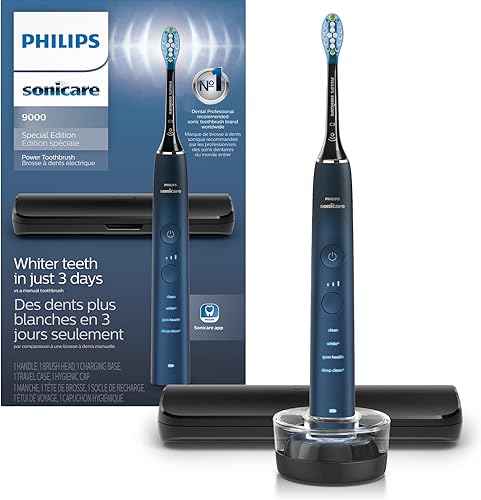
- 4 modes and 3 intensity levels
- C3 Premium Plaque Control brush head
- Smart pressure sensor with app pairing
- Up to 14 days per charge
- Travel case included
The top Sonicare here for people who want to switch modes and intensity to match each session. The app adds guided brushing and a replacement reminder.
Pros
- Four modes plus three intensity levels
- Pressure sensor warns through gentle vibrations
- Brush head replacement reminder tracks how hard you brush
- Travel case and charging stand included
Cons
- More settings than most people will use
- Premium price tier for the extra modes and app
The setup is aimed at people who like feedback. The pressure sensor tells you when you push too hard, and the replacement reminder tracks how often and how hard you brush before nudging you to swap heads.
Those two features work in the background without you changing any setting.
The model number is HX9911/92 and the handle weighs 1.33 pounds with the dimensions at 3.86 x 6.02 x 10 inches. That's a full-size adult handle rather than a compact travel brush, so it sits in a stand on the bathroom counter and packs into the included case for trips.
Who the DiamondClean 9000 suits
Buy it if you want to move between a daily clean, a whitening session and a gentler gum pass without owning two brushes. The four modes plus three intensity levels make that easy to manage.
Someone with sensitive gums can run Gum Health at the lowest intensity on a tender day and switch to White+ at a higher level when they want stain removal.
It also fits anyone who likes app support. The handle pairs with the Sonicare app for guided brushing, tips and content built around your routine.
If you already track other habits on your phone, adding brushing to the same routine is a natural fit.
Skip it if you brush on autopilot. A single-mode brush with a 2-minute timer does the same core job with far fewer choices, and you won't pay for settings you never touch.
The specs that matter in daily use
The numbers that change your routine are the bristle speed, modes and pressure feedback, not the finish on the handle. Philips Sonicare says the brush delivers up to 62,000 bristle movements per minute and uses Fluid Action to drive fluid between teeth and along the gumline.
That fluid movement is what reaches the gaps a manual brush can't scrub directly.
The 12 brushing settings come from four modes and three intensity levels. Clean is the everyday setting, White+ targets stains, Gum Health is the gentler pass and Deep Clean+ is the thorough option.
The three intensity levels sit alongside the modes rather than inside them, so every mode can run soft or strong.
The smart optic sensor watches pressure. Push too hard and the handle vibrates gently so you ease off, which helps protect your gums.
The 9000 pairs this with app feedback so you can see how your pressure changes over time.
Battery life is up to 14 days of regular brushing on a full charge. That figure assumes two 2-minute sessions a day, so a single person brushing twice daily gets about two weeks between charges.
A charging stand and a travel case come in the box, so the brush works at home and on trips.
Setting up the DiamondClean 9000
Setting up is charge, fit the head and pair the app, in that order. The handle arrives with one C3 Premium Plaque Control head, a charging stand and a travel case.
Put the handle on the stand and let it charge fully before the first use. Then press the brush head onto the handle until it sits firmly in place.
A loose head rattles and weakens the clean, so seat it all the way down.
If you plan to use the app, pair the handle with the Sonicare app before your first session. Guided brushing, tips and personalized content all run through that pairing.
The app also carries the replacement reminder data, so pairing early gives you a full picture of your brushing from day one. If you skip the app, the handle still works on its own with the mode and intensity buttons.
Pick a mode and an intensity level to start. Clean at a mid intensity is a sensible first setting, and you can move to White+, Gum Health or Deep Clean+ once you know how each feels.
Try each mode for a session or two before you settle on a favorite.
Caring for the brush and the brush head
Keep the routine simple: rinse the head after each use and let it air dry, then recharge when the battery gets low. Wipe the handle with a damp cloth rather than running it under the tap.
The replacement reminder takes the guesswork out of head changes. It tracks how often and how hard you brush, then signals when it's time for a new head.
Dental professionals recommend changing your brush head regularly, so follow the reminder rather than waiting for bristles to splay. Philips Sonicare notes that brush heads become less effective after three months.
Store the travel case open after a trip so trapped moisture can escape. Keep the charging stand dry and away from splashes at the sink.
The stand charges through contact rather than a plug, so a wet base is the one thing to avoid.
If the handle ever acts up, our guide to what to do when your Philips Sonicare won't turn off covers the common causes and fixes. Most issues trace back to a stuck button or a charging contact that needs a clean.
The trade-offs to know before you buy
The main trade-off is complexity for a routine task. Four modes and three intensity levels give you control, but most people settle on one or two settings and ignore the rest.
If you won't use the app, part of what you pay for goes unused.
The premium price tier is the second point. You're paying for the extra settings, the app pairing and the bundled travel case.
A basic Sonicare still cleans your teeth without those extras. The 4100 keeps the pressure sensor and timers but drops the mode switching.
The C3 Premium Plaque Control head is one specific head type. If you prefer a different bristle style, check what fits the handle before you buy replacements.
The replacement reminder assumes you're using a compatible head, so swapping to a non-Sonicare head can throw off its tracking.
The 14-day battery figure is also worth noting against the Aquasonic's four weeks. If you travel often and dislike packing a charger, the shorter run between charges is a real limitation.
The travel case helps, but it doesn't extend the battery.
None of these points make it a bad brush. They just mean the DiamondClean 9000 rewards people who actually use its settings.
If you want set-and-forget brushing, the simpler models below make more sense.
The alternatives worth comparing
The DiamondClean 9000 sits at the top of the range here, so the useful comparison is what you give up by spending less. Each alternative below covers a different priority.
If you want to understand what each setting does before you commit, our Sonicare modes guide explains the differences in plain terms. Mode names across the Sonicare range describe the same broad jobs, so a White+ session on the 9000 aims at the same goal as a whitening mode on a cheaper handle.
Sonicare 4100
The Sonicare 4100 is the straightforward daily brush of the group. It runs one cleaning mode with the C2 Optimal Plaque head, and Philips Sonicare says that head removes up to 700% better plaque than a manual toothbrush.
The head has soft, flexible, stain-removal bristles rather than the dense center cluster on the C3.
Its coaching features are the draw. EasyStart raises power gradually over the first 14 uses, SmarTimer marks the 2-minute point and QuadPacer gives 30 seconds per mouth section.
A pressure sensor pulses the handle if you press too hard. EasyStart matters most for a first sonic brush, because it lets you adjust to the faster bristle motion without an intense first week.
It also runs up to 14 days per charge. The box has the handle, one C2 head and a USB charger, with no travel case.
The model number is HX3681/24 and the handle is lighter than the 9000 at 8.64 ounces. Our full Sonicare 5300 review shows how the step-up model compares if you want a little more than the 4100 offers.
Aquasonic Vibe Series Ultra-Whitening Toothbrush
The Aquasonic Vibe Series is the long-supply option here. Its box includes eight DuPont brush heads, which at three months each covers about two years before you buy replacements.
That removes the repeated head purchases that make sonic brushing more expensive over time.
It uses a 40,000 VPM motor with four modes and a smart vibration timer. The handle is IPX7 waterproof, and a wireless charging base replaces a plug-in stand.
Four modes plus a smart timer cover similar ground to the 9000's layout, though without the three-level intensity control.
The hard shell travel case holds two heads and is made of BPA-free plastic. Aquasonic says the brush runs up to four weeks per charge, which is longer than the DiamondClean 9000's stated 14 days.
For a frequent traveler, that difference matters more than the mode count.
The American Dental Association has accepted it for removing plaque and helping prevent and reduce gingivitis. It's not a Sonicare, so you won't get the app pairing or the four-mode, three-intensity layout.
The motor speed is also rated differently, at 40,000 vibrations per minute against the Sonicare's bristle movement figure, so the two numbers aren't directly comparable.
Where the DiamondClean 9000 still wins
The 9000's advantage is fine control. Three intensity levels let you soften the clean on a tender day without switching to a different brush, and the app tracks how you brush over time.
The 4100 has no intensity setting at all, and the Aquasonic's modes don't stack with intensity levels the way the 9000's do.
Its C3 Premium Plaque Control head is built for polishing and whitening, which suits people chasing stain removal. The pressure sensor and replacement reminder also give you feedback that the simpler handles either lack or reduce to a single pulse.
Verdict: buy it or skip it?
Buy the DiamondClean 9000 if you'll use its modes and intensity levels and want app guidance on top. It's the most flexible Sonicare here, and the pressure sensor and replacement reminder make daily brushing easier to manage.
The 14-day battery and included travel case keep it practical for regular trips.
Skip it if you want one setting and a timer. The 4100 does that core job at a lower price tier, and the Aquasonic covers two years of heads in one box if replacements are your bigger cost.
The 9000 is a brush for people who treat brushing as a routine worth tuning.
For most people deciding on a Sonicare, the choice comes down to how much control you'll actually use. If you want to compare the full range first, our guide to the best Sonicare toothbrushes for the price lines up the models by what each one adds.
Start with how many settings you'll really touch, and the answer usually sorts itself out.
How we scored the DiamondClean 9000
Our score weighs specs, features and buyer intent against what you're shopping for. The DiamondClean 9000 earns 9.7 because it leads on adjustability: four modes, three intensity levels and app pairing in one handle.
The 4100 scores 8.4 as a simpler daily brush with the core coaching features. The Aquasonic scores 9.5 for its eight-head supply, longer stated battery life and ADA acceptance.
We compared the published specs and features rather than testing the brushes in person. The scores reflect how well each brush serves its intended buyer, so the 4100's lower mark is about its narrower feature set, not a weak clean.
Frequently asked questions
How many brushing modes does the DiamondClean 9000 have?
It has four modes: Clean, White+, Gum Health and Deep Clean+. Each one can run at one of three intensity levels, giving 12 combinations in total.
Does the DiamondClean 9000 tell you when you brush too hard?
Yes. A smart optic sensor detects excessive pressure and alerts you through gentle vibrations so you can ease off.
That helps protect your gums during daily brushing.
How long does the DiamondClean 9000 battery last?
Philips Sonicare says it provides up to 14 days of regular brushing on a full charge. A charging stand comes in the box, and there is also a travel case for trips.
What comes in the DiamondClean 9000 box?
The set includes the DiamondClean 9000 handle, one C3 Premium Plaque Control brush head, a charging stand and a travel case.
Is the DiamondClean 9000 worth it over the Sonicare 4100?
Choose the 9000 if you want selectable modes, intensity levels and app guidance. The 4100 covers the basics with one mode and the core coaching features at a lower price tier.


