9 Best Electric Toothbrushes for Braces (November 2026)
The best electric toothbrushes for braces include the Oral-B Pro 1000 for braces overall, the Philips Sonicare 1100 for a gentle start, and the Oral-B iO Series 3 for tracking pressure.
On this page (8 sections)
The best electric toothbrush for braces for most people is the Oral-B Pro 1000, because its round head reaches around brackets and its Gum Pressure Control stops the brush when you press too hard. Pick the Philips Sonicare 1100 if your gums need a gentler start, or the Oral-B iO Series 3 if you want a light that shows your pressure in real time.
Braces change the job a toothbrush has to do. Brackets and wires create ledges where plaque settles, and the gums around them get sore quickly when you scrub.
A brush that cleans well but presses too hard can leave your gums tender for days after an adjustment.
So the features that matter most here are a small head that can reach around hardware, a pressure limit, and a timer that keeps you moving. Speed and app features come a distant second.
That ordering shapes every pick below.
We weighed each model's head shape, pressure control, modes, timer and battery against what a person in braces actually needs twice a day. Our score weighs specs, features and buyer feedback against what you're shopping for.
The best electric toothbrushes with a pressure sensor roundup goes deeper on that one feature if it matters most to you.
Our picks at a glance
-
1

-
2

-
3

- 4
 Best for gum care modesCheck it
- 5
 Best for head supplyCheck it
- 6
 Check it
7MAGIC Sonic Electric Toothbrush
Best for long battery life - 7
 Check it
7AM2M Sonic Electric Toothbrush
Best for travel charging - 8
 Best for family sharingCheck it
- 9
 Best for light handlingCheck it
The best electric toothbrushes for braces
The Oral-B Pro 1000 wins on the basics for braces, while the other picks each handle a specific case better. Start with the overall pick unless one of the named needs below describes you.
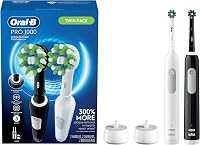
Oral-B Pro 1000: Best for braces overall
- Round brush head
- Gum Pressure Control
- Three cleaning modes
- Quadrant timer
A round head and an automatic pressure stop make it the easiest fit for daily cleaning around brackets.
Pros
- Gum Pressure Control
- Round head reaches around brackets
- Quadrant timer in 30-second steps
Cons
- No travel case in the box
- Basic charge indicator only
The Pro 1000 is the pick for most people in braces because its round head does the work in small circles around each bracket. Oral-B says the round shape reaches where rectangular manual heads don't, and that matters most at the gumline under a wire.
The bristles on the CrossAction head are angled at 16 degrees to surround each tooth, which is the geometry that lets it hug a bracket instead of skidding past it.
Gum Pressure Control stops the brush pulsations when you press too hard. That's the single most useful feature here, since sore gums around brackets usually come from too much force rather than too little cleaning.
The handle also carries a charge indicator light so you know when the battery needs topping up.
It runs three cleaning modes, including a sensitive one, and the handle ticks every 30 seconds so you move through all four quadrants. The in-handle timer is what makes a two-minute brush feel natural rather than long.
The trade-off against the iO Series 3 is that the Pro 1000 doesn't show your pressure in real time; it just stops the brush. It also ships without a travel case.
For a first electric brush during treatment, neither is a reason to pay more. Oral-B backs it with a 30-day money-back guarantee if you want to try it without much risk.
Philips Sonicare 1100: Best for a gentle start
- C1 Simply Clean head
- EasyStart ramp-up
- SmarTimer and QuadPacer
- Up to 14 days per charge
EasyStart raises power over the first 14 uses, which helps when your gums are sore after an adjustment.
Pros
- EasyStart eases you into sonic brushing
- Up to 14 days per charge
- QuadPacer in 30-second steps
Cons
- No pressure sensor
- Single cleaning mode
The Sonicare 1100 is the gentle option. It uses the C1 Simply Clean head with soft, flexible bristles, and Philips says the Advanced Sonic Technology pulses fluid between teeth and along the gumline.
That fluid action is useful around brackets you can't reach with a straight stroke, because the movement carries saliva and toothpaste into the gaps the bristles miss.
EasyStart raises the power gradually over the first 14 uses. If your gums are tender right after an adjustment, that slow ramp is kinder than a brush that hits full power on day one.
It also gives you time to learn how much pressure feels right before the motor is running flat out.
SmarTimer marks the two minutes and QuadPacer splits the mouth into 30-second blocks. Philips says a full charge lasts up to 14 days of regular brushing, which covers a fortnight away from the charger without thinking about it.
The clear trade-off is the missing pressure sensor. Nothing warns you when you press too hard, so you have to judge by feel.
It also offers a single mode, so there's no sensitive setting to switch into when your mouth is sore. If pressure feedback matters, the Pro 1000 above costs less and gives you more.
Oral-B iO Series 3: Best for tracking pressure
- Smart pressure sensor with light ring
- Three modes
- Two replacement heads
- Travel case
The light ring tells you when you press too hard, so you can correct your grip before your gums complain.
Pros
- Light ring shows pressure in real time
- Two brush heads included
- Travel case in the box
Cons
- Higher price tier than the other picks
- Replacement heads cost more than standard Oral-B heads
The iO Series 3 is for people who want to see their pressure rather than just feel it. Its smart pressure sensor drives a light ring on the handle, so you get a visual warning before your gums pay the price.
For anyone who brushes hard without noticing, that's a real upgrade, and it's the closest thing here to a coach sitting on the sink.
It offers three modes: Daily Clean, Sensitive and Whitening. The round iO head works on the same principle as the Pro 1000, reaching around brackets with small circular motions, but Oral-B pairs the spinning with gentle micro-vibrations for a smoother feel.
The company claims up to 400% more plaque removal along the gumline than a manual brush. The timer gives 30-second quadrant prompts.
In the box you get two replacement heads and a travel case, which softens the higher price. The trade-off is the running cost after those two heads wear out; iO replacement heads cost more than standard Oral-B heads.
The Pro 1000 cleans the same way for less, so choose the iO only if the light ring will genuinely change how you brush.
Sonicare 5300: Best for gum care modes
- Three modes including Gum Care
- Pressure sensor
- BrushSync reminder
- Travel case and three heads
Gum Care mode adds a minute of reduced-power brushing, a sensible extra step when brackets irritate your gums.
Pros
- Gum Care mode for tender gums
- Pressure sensor
- Travel case and three heads
Cons
- Bulkier handle than the 1100
- BrushSync reminder needs matching heads
The Sonicare 5300 is the pick if gum tenderness is your main complaint. Its Gum Care mode adds an extra minute of reduced-power brushing to massage the gums, and the handle carries a pressure sensor that alerts you when you press too hard.
Philips says the brush supports gum health up to 100% better than a manual brush.
Three modes cover clean, white and gum care, so you can switch to the gentle setting on the days your mouth feels raw. The handle also offers three intensity settings, which gives you finer control than a plain mode switch.
That combination is what makes it the most adjustable brush here for a sore mouth.
BrushSync tracks how long you've used a head and how hard you've been brushing, then gives a short beep when it's time to change it. Braces wear heads faster, so that reminder earns its place.
The set includes a travel case, a charger and three heads: one G2 Optimal Gum Care and two DiamondClean heads for stain removal.
It's bulkier in the hand than the 1100 and sits in a higher price tier. If your orthodontist has told you to baby your gums, the extra modes and the sensor together make it the more useful brush.
The extra intensity steps are the part the cheaper sonics can't match.
Aquasonic Black Series: Best for head supply
- Eight DuPont brush heads
- Four modes
- Wireless charging
- Travel case
Eight heads in the box means about two and a half years of replacements, useful when braces wear heads faster.
Pros
- Eight brush heads included
- ADA accepted
- Travel case
Cons
- No pressure sensor
- Vibration-only action rather than a rotating head
The Aquasonic Black Series is the supply pick. It arrives with eight DuPont brush heads, and at a head every 3 to 4 months that's about two and a half years of replacements.
With braces, heads fray faster than usual, so the spare supply matters more than it would for someone with smooth teeth. You won't be caught short mid-treatment.
It offers four modes and 40,000 vibrations per minute, plus wireless charging and a hard-shell travel case. The case has room for two heads.
Aquasonic says the battery lasts about four weeks on a full charge with two two-minute brushes a day. The handle is IPX7 waterproof, so it can be rinsed and used in the shower.
The head is a sonic vibration design rather than a round rotating one, and there's no pressure sensor. That makes it a good second brush or a budget way to keep spare heads in the bathroom drawer.
The set carries the ADA seal, which is a useful signal of basic cleaning claims. For gum protection during treatment, the Pro 1000 is still the safer primary.
7MAGIC Sonic Electric Toothbrush: Best for long battery life
- Up to 180 days per charge
- Eight brush heads
- Five modes and three intensities
- IPX7 waterproof
A 2000mAh battery that runs months between charges suits a bag, a locker or a dorm room.
Pros
- Runs up to 180 days per charge
- Five modes and three intensities
- Eight heads included
Cons
- No pressure sensor
- USB charging cable only, no adapter
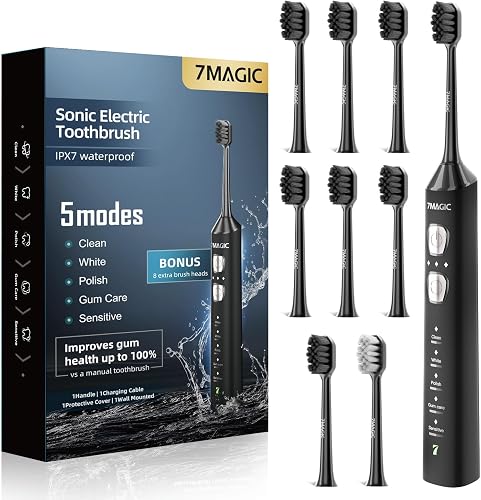
The 7MAGIC is for anyone who forgets to charge. Its 2000mAh battery runs up to 180 days between charges, so a brush that lives in a school bag or a locker stays ready.
A low-battery indicator and auto shut-off when full keep the charging simple. Six months between charges is a different kind of convenience from the two-week brushes here.
It carries five modes and three intensity settings, which lets you drop to a gentle setting for sore gums and step up when things settle. The W-shaped bristle layout is designed to follow tooth contours and reach the gumline.
7MAGIC says the motor produces 42,000 vibrations per minute.
Eight heads are in the box, seven standard and one deep-cleaning, which covers about two years. It's IPX7 waterproof and has a two-minute timer with 30-second prompts.
The set also includes a brush head cover and a hanger, small extras that help keep a shared bathroom tidy.
The catch is the lack of a pressure sensor, and it charges by USB cable without an adapter. As a travel or backup brush for braces it works well; as your only brush, the pressure protection of the Pro 1000 is worth more.
The long battery is the reason to pick it.
7AM2M Sonic Electric Toothbrush: Best for travel charging
- USB Type-C charging
- Up to 120 days per charge
- Six W-shaped heads
- Five modes
Type-C charging means one cable for your phone and your brush, handy for a school bag or a shared bathroom.
Pros
- USB Type-C charging
- Up to 120 days per charge
- Six heads included
Cons
- No pressure sensor
- No travel case
The 7AM2M suits a shared bathroom or a commuting routine because it charges by USB Type-C. One cable covers your phone and your brush, and a single charge runs up to 120 days depending on use.
That cable standard matters more than it sounds when your bag already carries a laptop charger.
Six W-shaped heads come in the box, which covers up to 18 months at a head every 3 months. The soft bristles have blue indicator filaments that fade as a replacement cue, a small detail that helps when braces are already wearing your heads down.
You can see when a head is past its best without counting months.
Five modes include Sensitive for tender days and White for surface stains. The timer pauses every 30 seconds to move you around the mouth.
The package weighs 7.05 ounces, so the handle sits on the lighter side for a sonic brush. 7AM2M backs it with a lifetime guarantee beyond the return window.
It has no pressure sensor and no travel case, so the value is in the heads and the charging convenience. Pick it for a second brush or for a teen in braces who needs a simple, portable setup.
Pick the Sonicare 1100 instead if gum comfort is the priority.
COSLUS C40: Best for family sharing
- Six brush heads
- Five modes
- Travel case
- IPX7 waterproof
Six heads and five modes let siblings share one handle without losing track of whose head is whose.
Pros
- Six heads for family use
- Travel case included
- Sensitive mode among five
Cons
- No pressure sensor
- No adapter in the box
The COSLUS C40 is the family pick. Six heads and five modes let siblings or a couple share one handle and still keep their own heads straight.
The sensitive mode is the one to use when braces have your gums complaining. COSLUS says the brush suits ages 12 and up, so it covers a household with more than one person in treatment.
It has an IPX7 waterproof body and a travel case that keeps the handle dry in a bag. COSLUS says the battery runs twice as long as typical rivals and lists a wireless charging base for faster top-ups.
A two-minute timer with 30-second pulses keeps brushing even. The handle weighs 81g, which the company pitches as easy to grip for kids and older users.
The 47,000 VPM motor is the highest figure in this group, but speed isn't what braces need most; control is. There's no pressure sensor, so you have to keep your grip light on your own.
It's a sensible shared handle for a family in treatment, not the best single-user pick. For one person, the extra heads are simply spare stock.
TEETHEORY Electric Toothbrush: Best for light handling
- Weighs 55g
- Eight brush heads
- Five modes
- IPX7 waterproof
At 55g it's light enough for a younger wearer to hold steady while working around wires and bands.
Pros
- Light 55g handle
- Six brush heads, a tongue scraper and an interdental brush
- Five modes including Sensitive
Cons
- No pressure sensor
- Shortest battery life in this group at 30 days
The TEETHEORY is the lightest handle here at 55g, less than half the weight of a typical sonic brush. That matters for younger wearers or anyone who finds a heavier handle tiring to hold steady around wires and bands.
A light handle makes it easier to keep the head angled at the bracket rather than pressed into it.
It offers five modes including Sensitive, plus 6 brush heads, a tongue scraper and an interdental brush. TEETHEORY says the fast charge takes about 4 hours and the battery lasts 30 days at two brushes a day.
The timer pauses every 30 seconds and shuts the brush down at two minutes.
The interdental brush in the box is worth noting for braces, because cleaning between brackets and the wire needs something thin. The trade-offs are real: no pressure sensor, and the battery life is on the shorter side in this group.
Pick it when light handling and a big head supply matter more than gum protection, and consider the Pro 1000 as the primary brush for the harder-to-reach spots.
How the picks compare
The table below lines up head type, pressure control and modes so you can see at a glance which brushes protect your gums and which just clean. Read the pressure row first, because it decides most of the ranking for braces.
| Product | Best for | Brush head | Pressure control | Modes | Our score |
|---|---|---|---|---|---|
| Oral-B Pro 1000 | braces overall | Round, oscillating-rotating | Stops pulsations when brushing too hard | 3 | 9.6 |
| Philips Sonicare 1100 | a gentle start | C1 Simply Clean, soft flexible bristles | None | 1 | 9.1 |
| Oral-B iO Series 3 | tracking pressure | Round iO head | Smart sensor with light ring | 3 | 8.7 |
| Sonicare 5300 | gum care modes | G2 Optimal Gum Care plus 2 DiamondClean heads | Sensor with handle alert | 3 | 8.7 |
| Aquasonic Black Series | head supply | DuPont engineered | None | 4 | 8.5 |
| 7MAGIC Sonic Electric Toothbrush | long battery life | W-shaped bristles | None | 5 plus 3 intensities | 8.4 |
| 7AM2M Sonic Electric Toothbrush | travel charging | W-shaped soft bristles | None | 5 | 8.3 |
| COSLUS C40 | family sharing | W-shaped soft bristles | None | 5 | 8.2 |
| TEETHEORY Electric Toothbrush | light handling | W-shaped, high-density bristles | None | 5 | 8.1 |
The pattern is simple. The two Oral-B brushes with active pressure control, the Pro 1000 and the iO Series 3, are the safest for braces, and the Sonicare 5300 adds a dedicated gum mode.
The rest of the group compete on head supply, battery life and price rather than gum protection. That split is the whole story of this roundup: six brushes clean, but only three watch your grip.
How these were compared
We started from what braces demand: a head that reaches around brackets and wires, a way to stop over-brushing, and a timer that covers all four quadrants. Then we checked each model's published specs for those features.
Head shape came first. Round oscillating-rotating heads reach around brackets in small circles, while sonic heads rely on vibration and fluid movement.
Both clean, but the round design is easier to steer around hardware. A wide head that bumps into a bracket leaves the gumline under the wire untouched.
Pressure control came second. The Pro 1000 stops its pulsations when you press too hard and the iO Series 3 adds a light ring.
The Sonicare 5300 warns through the handle. The rest have no pressure feature, which we counted against them for this use.
We treated a warning as better than nothing and an automatic stop as the strongest option.
Then we looked at modes, timers and battery life. A sensitive mode helps on sore days, and a quadrant timer is non-negotiable when brackets make each zone take longer.
Head supply and travel cases broke ties where the cleaning specs were close. A brush with six or eight heads in the box saves repeat buying during a treatment that can run two years or more.
What should you look for in an electric toothbrush for braces?
Look for a soft or sensitive head, active pressure control and a two-minute timer with 30-second prompts. Everything else is optional.
The order matters: pressure control first, head shape second, and everything else after that.
Head shape and size
A small round head or a compact sonic head can reach between brackets and along the wire. A wide head bumps into brackets and misses the gumline underneath.
The 16-degree bristle angle on Oral-B's round head is designed to wrap a tooth, which is why it suits hardware. Sonic heads with a W-shaped bristle profile follow the tooth contour and pulse fluid into the gaps.
Pressure control
An active pressure sensor stops or warns when you press too hard. This is the feature that separates the top picks here from the budget group.
Without it, you judge force by feel, and most people press harder than they think. The Pro 1000 stops the brush; the iO Series 3 and the 5300 warn you.
Modes and timer
A sensitive or gum care mode gives you somewhere to go when your mouth is sore after an adjustment. A quadrant timer matters more with braces, because each zone takes longer and it's easy to rush the back teeth.
The extra minute in the Sonicare 5300's Gum Care mode is a good example of a mode built for a specific problem rather than a longer feature list.
Battery and head supply
Braces wear brush heads faster, so a model that ships with six or eight heads saves repeat buying. Long battery life helps if the brush travels to school or work.
A 180-day battery like the 7MAGIC's and an eight-head box like the Aquasonic's solve different problems.
Do you need a pressure sensor when you wear braces?
Yes, a pressure sensor is worth having when you wear braces. Sore gums and worn enamel around brackets usually come from brushing too hard, and a sensor catches that before it becomes a problem.
The Pro 1000 handles it by stopping the brush when you press too hard. The iO Series 3 shows you with a light ring.
The Sonicare 5300 alerts through the handle. If your budget won't stretch, choose a soft head and a light grip, and move to the best electric toothbrush under 100 if you want more for your money.
An orthodontist's advice on your specific hardware should still come first.
Which brush head works best around brackets?
A soft, small head works best around brackets. Round heads reach around the hardware in small circles, while W-shaped sonic heads follow the tooth contour and pulse fluid between teeth.
Bristle softness matters too, because stiff bristles on a sore gumline undo the benefit of a gentle motor.
Both designs clean well when used gently and for the full two minutes. The deciding factor is usually comfort: if your gums are sore, a soft sonic head feels gentler, while a round head is easier to steer around a wire.
People with crowded teeth alongside braces may also find a compact head easier to fit between surfaces. Whichever head you pick, replace it every three months or sooner once the bristles splay.
Which pick suits which wearer?
The overall pick suits most people in braces. The others each fit a specific situation, so match the brush to your main problem rather than to the longest feature list.
If two needs overlap, buy the one with pressure control.
For most people in braces
The Oral-B Pro 1000 gives you a round head and active pressure control for the lowest outlay in this group. It's the brush we'd buy first.
The sensitive mode and the quadrant timer cover the rest of what treatment asks for.
For sore gums
The Sonicare 1100's EasyStart ramp or the Sonicare 5300's Gum Care mode both ease you in. Choose the 5300 if you also want a pressure sensor; choose the 1100 if you want the lowest-cost gentle start.
The 5300's extra intensity settings give you more room to dial down on a bad day.
For families and travel
The COSLUS C40 and the 7AM2M suit shared bathrooms and bags. Six heads and Type-C charging keep costs and cables down.
For older wearers in the household, the best electric toothbrushes for seniors covers lighter handles and simpler controls. If someone in the house needs a brush for a bag or a locker, the 7MAGIC's long battery also fits that case.
Verdict
The best electric toothbrush for braces for most people is the Oral-B Pro 1000, because it combines a round head that reaches around brackets with Gum Pressure Control that stops you over-brushing. It also runs a quadrant timer and a sensitive mode, which is more than enough for daily treatment.
Buy the Sonicare 1100 if you want the gentlest possible start and don't mind judging pressure by feel. Buy the iO Series 3 if seeing your pressure on a light ring will change how you brush.
Buy the Sonicare 5300 if gum care mode and a sensor together are worth the higher price.
Everyone else in this group is a second brush or a budget backup. Head supply and battery life are nice, but around braces the pressure control is what protects your gums and your enamel.
If you're also shopping for an older wearer or a tighter budget, the related roundups below cover those cases.
Our top 3 picks at a glance
-
1
-
2
-
3
Frequently asked questions
Is a round or sonic brush head better for braces?
Round oscillating-rotating heads like the Oral-B Pro 1000 reach around brackets and along the gumline with small circular strokes. Sonic heads move side to side and pulse fluid between teeth.
Both work, so choose the one you'll use twice a day.
Do I need a pressure sensor with braces?
A pressure sensor helps, because sore gums around brackets are common and brushing hard makes it worse. The iO Series 3 warns you; the Pro 1000 stops the brush.
If your budget is tight, a soft head and a light grip do most of the same job.
How often should you change a brush head with braces?
Every 3 months, or sooner if the bristles splay. Braces and bands wear bristles faster than smooth teeth do, so check the head each month and replace it when the bristles start to bend out of shape.